An autodyning receiver architecture using tunnel diode oscillators for long-range, low-power reception
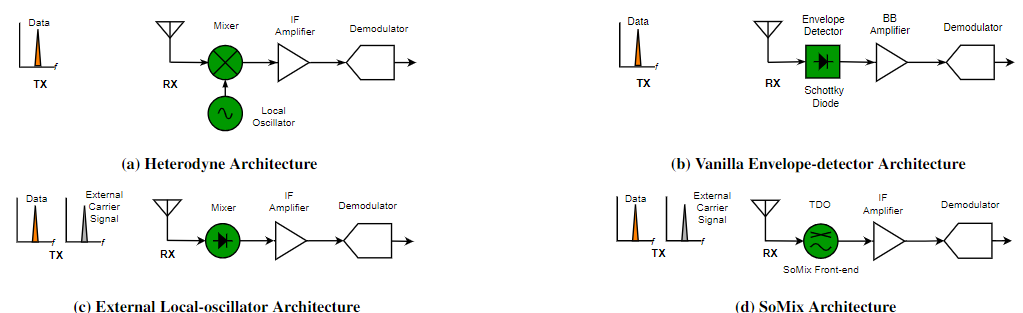
Low-power transmission has advanced a great deal, but low-power reception over similarly useful ranges has lagged behind — most low-power receivers rely on Schottky diode envelope detectors, which are limited in sensitivity and can’t support complex modulation. SoMix (Single Oscillator Mixer) uses the autodyning property of tunnel diode oscillators to generate a carrier signal and perform signal downconversion in the same circuit, merging two traditionally power-hungry analog tasks into one energy-efficient step.
The SoMix front-end (left) consumes under 100 μW while supporting high-sensitivity reception; the demo setup (right) shows range testing in the field.
Through injection-locking, SoMix stabilizes its tunnel diode oscillator using even a weak external carrier, receiving FM transmissions from over 100 m in line-of-sight. It outperforms state-of-the-art low-power receivers on power, range, and functionality (Medaranga et al., 2025).
References
2025
MobiSys
Unraveling the Missing Link in Low-power Communication: An Autodyning Receiver Architecture that Achieves a Long Range
Sooriya Patabandige Pramuka Medaranga , C. Rajashekar Reddy , Wenqing Yan , Prabal Dutta , and Ambuj Varshney
In Proceedings of the 23rd ACM International Conference on Mobile Systems, Applications and Services (MobiSys ’25), 2025
Wireless communication remains the most power-intensive operation in embedded systems. Decades of research have enabled radio transmitters to operate at power levels as low as tens of μWs while maintaining practical communication ranges. However, achieving power-efficient reception over similarly useful distances has received significantly less attention. State-of-the-art low-power receivers typically rely on Schottky diode-based envelope detectors, which are inherently limited in sensitivity and unable to support complex modulation schemes. We introduce SoMix, the Single Oscillator Mixer receiver, a novel architecture that uses tunnel diode oscillators to overcome these limitations. Specifically, we demonstrate the autodyning property of tunnel diode oscillators, allowing a single circuit to generate both a carrier signal and perform signal downconversion, thus merging two traditionally power-hungry analog tasks into one energy-efficient step. The SoMix front-end consumes less than 100 μW while supporting high-sensitivity reception. Through injection-locking, SoMix stabilizes its tunnel diode oscillator using even a weak external carrier signal, allowing it to receive frequency-modulated transmissions from distances greater than 100 meters in line-of-sight environments. We also demonstrate that the SoMix exhibits robustness in complex real-world scenarios. SoMix outperforms state-of-the-art receivers in power, range, and functionality.
@inproceedings{medaranga2025unraveling,title={Unraveling the Missing Link in Low-power Communication: An Autodyning Receiver Architecture that Achieves a Long Range},author={Medaranga, Sooriya Patabandige Pramuka and Reddy, C. Rajashekar and Yan, Wenqing and Dutta, Prabal and Varshney, Ambuj},booktitle={Proceedings of the 23rd ACM International Conference on Mobile Systems, Applications and Services (MobiSys '25)},year={2025},pages={1--14},address={Anaheim, CA, USA},publisher={ACM},doi={10.1145/3711875.3729164},category={Full Paper}}