Low-power, non-contact sensing using tunnel diode oscillators
Many sensing scenarios — tracking occupancy, monitoring vital signs, diagnosing machine faults — need to observe motion without touching the object at all. TunnelSense rethinks non-contact sensing using tunnel diode oscillators, which are highly sensitive to changes in their surrounding electromagnetic environment: an object moving nearby shifts the oscillator’s resonant frequency, and therefore the radio waves it generates.
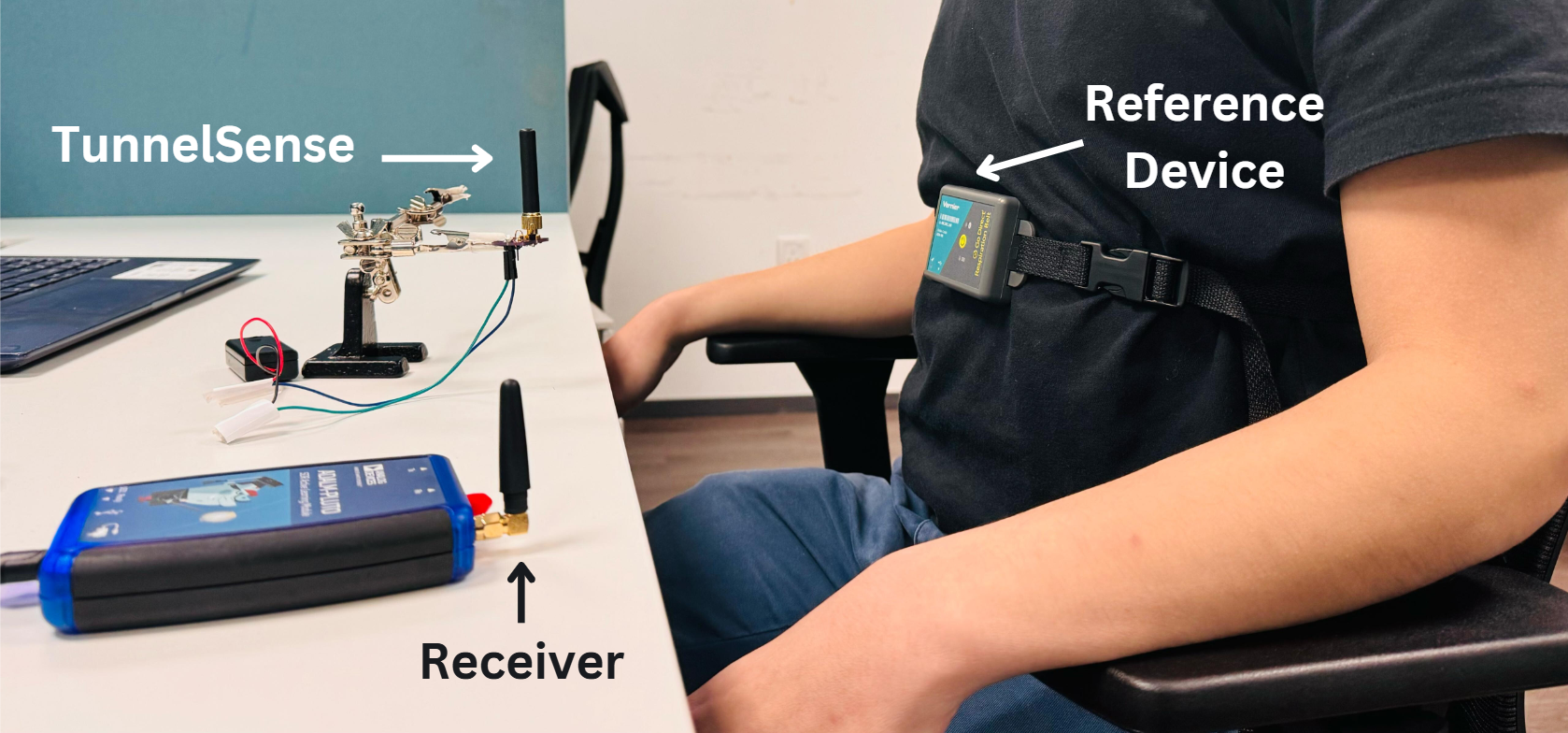
The TunnelSense receiver and reference device setup (left) and sensor tag (right).
Tags built on this principle run on under 100 μW with a bias voltage starting at just 70 mV, enabling long operation on a small battery or harvested energy. In this work we demonstrate breathing detection at distances up to 30 cm between subject and tag (Thaddeus et al., 2024).
References
2024
RFID
TunnelSense: Low-Power, Non-Contact Sensing Using Tunnel Diodes
Lim Chang Quan Thaddeus* , C. Rajashekar Reddy* , Yuvraj Singh Bhadauria , Dhairya Shah* , Manoj Gulati , and Ambuj Varshney
In 2024 IEEE International Conference on RFID (RFID), 2024
Sensing the motion of physical objects in an environment enables numerous applications, from tracking occupancy in buildings and monitoring vital signs to diagnosing faults in machines. Typically, these application scenarios involve attaching a sensor, such as an accelerometer, to the object of interest, like a wearable device that tracks our steps. However, many of these scenarios require tracking motion in a noncontact manner where the sensor is not in touch with the object. A sensor in such a scenario observes variations in radio, light, acoustic, and infrared fields disturbed by the object’s motion. Current noncontact sensing mechanisms often require substantial energy and involve complex processing on sophisticated hardware. We present TunnelSense, a novel mechanism that rethinks noncontact sensing using tunnel diode oscillators. They are highly sensitive to changes in their electromagnetic environments. The motion of an object near a tunnel diode oscillator induces corresponding changes in its resonant frequency and thus in the generated radio waves. Additionally, the low-power characteristics of the tunnel diode allow tags designed using them to operate on less than 100 μW of power consumption and with a biasing voltage starting at 70 mV. This enables prolonged tag operation on a small battery or energy harvested from the environment. Among numerous applications enabled by the TunnelSense system, this work demonstrates its ability to detect breathing at distances up to 30 cm between the subject and the TunnelSense tag.
@inproceedings{thaddeus2024tunnelsense,title={TunnelSense: Low-Power, Non-Contact Sensing Using Tunnel Diodes},author={Thaddeus, Lim Chang Quan and Reddy, C. Rajashekar and Bhadauria, Yuvraj Singh and Shah, Dhairya and Gulati, Manoj and Varshney, Ambuj},booktitle={2024 IEEE International Conference on RFID (RFID)},year={2024},pages={154--159},address={Cambridge, MA, USA},doi={10.1109/RFID62091.2024.10582671},co_primary={Thaddeus, Reddy, Shah},category={Full Paper}}