A microwatt-power, stable, standalone microwave oscillator that returns low-power wireless communication to a true two-device architecture
For a decade, low-power wireless communication has relied on a delegation architecture, offloading carrier generation to a dedicated external emitter to keep the tag’s own power budget in the microwatts. This works, but the resulting three-device topology (tag, emitter, receiver) complicates real-world deployment. Returning to a true two-device architecture on a microwatt budget was thought to be out of reach, since stable microwave oscillators are inherently power-hungry.
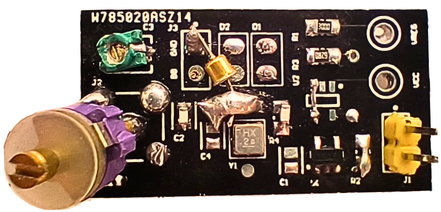
The M² (Microwatt Microwave) oscillator, coupling a tunnel diode with a high-Q SAW resonator.
M² breaks that trade-off between stability and power: by coupling a tunnel diode with a high-Q SAW resonator, it generates microwave signals below 105 μW while holding stability to a few ppm — at least two orders of magnitude better than prior tunnel diode oscillators, maintained across temperature, humidity, and motion, including in uncontrolled real-world conditions. Its self-oscillating mixing and autodyning also collapse the transmitter and receiver into a single microwatt frontend, achieving a 135 m line-of-sight range and tens of meters tag-to-tag.
M² was recognized as a Featured Paper (top 10 of 302 submissions) at ACM MobiSys ‘26 (Sooriya Patabandige et al., 2026), and its companion poster and ISLPED demo separately won a Best Poster Award Runner-Up and an Honourable Mention at the ISLPED Circuit Design Contest.
References
2026
MobiSys
Microwatt Microwave (M²) Oscillator: Going Beyond the Delegation Architecture of Low-power Wireless Communication
Pramuka Sooriya Patabandige , Dhairya Shah , C. Rajashekar Reddy , Spanddhana Sara , Prabal Dutta , and Ambuj Varshney
In Proceedings of the 24th Annual International Conference on Mobile Systems, Applications and Services (MobiSys ’26), 2026
For the past decade, low-power communication has relied on a delegation architecture that offloads carrier signal generation to external emitter devices. Although this reduces transmitter and receiver power, the resulting three-device topology introduces deployment complexity that has hindered wider adoption. Returning to a true two-device architecture on a microwatt budget was considered impossible because stable microwave oscillators are inherently power-hungry. We introduce M2, which breaks the trade-off between stability and power. The key contribution is an oscillator that generates microwave signals below 105 μW while maintaining stability of a few ppm, achieved by coupling a tunnel diode with a high-Q SAW resonator. Over a multi-hour deployment, this stability is at least two orders of magnitude better than state-of-the-art tunnel diode oscillators and is maintained across controlled variations in temperature, humidity, and motion, as well as uncontrolled real-world conditions including a crowded university food court and outdoor environment with direct sun exposure. Furthermore, M2 exhibits self-oscillating mixing and autodyning, enabling standalone transmitters and receivers that achieve 135 m line-of-sight range and -75 dBm reception sensitivity, with ranges exceeding tens of meters in tag-to-tag topology. M2 takes a major step beyond the de facto delegation architecture, enabling a new class of stable, standalone microwatt microwave (M2) radio transceivers.
@inproceedings{m2_mobisys26,title={Microwatt Microwave (M²) Oscillator: Going Beyond the Delegation Architecture of Low-power Wireless Communication},author={Sooriya Patabandige, Pramuka and Shah, Dhairya and Reddy, C. Rajashekar and Sara, Spanddhana and Dutta, Prabal and Varshney, Ambuj},booktitle={Proceedings of the 24th Annual International Conference on Mobile Systems, Applications and Services (MobiSys '26)},year={2026},pages={941--959},address={New York, NY, USA},publisher={Association for Computing Machinery},doi={10.1145/3745756.3809248},category={Full Paper}}

 Microwatt Microwave (M²) Oscillator: Going Beyond the Delegation Architecture of Low-power Wireless CommunicationIn Proceedings of the 24th Annual International Conference on Mobile Systems, Applications and Services (MobiSys ’26), 2026🏅 Featured Paper (Top 10/302)🏅 Best Poster Award Runner-Up🏅 ISLPED Circuit Design Contest, Honourable Mention