Ubiquitous connectivity for embedded systems via FM audio-broadcasting, beyond-backscatter tags
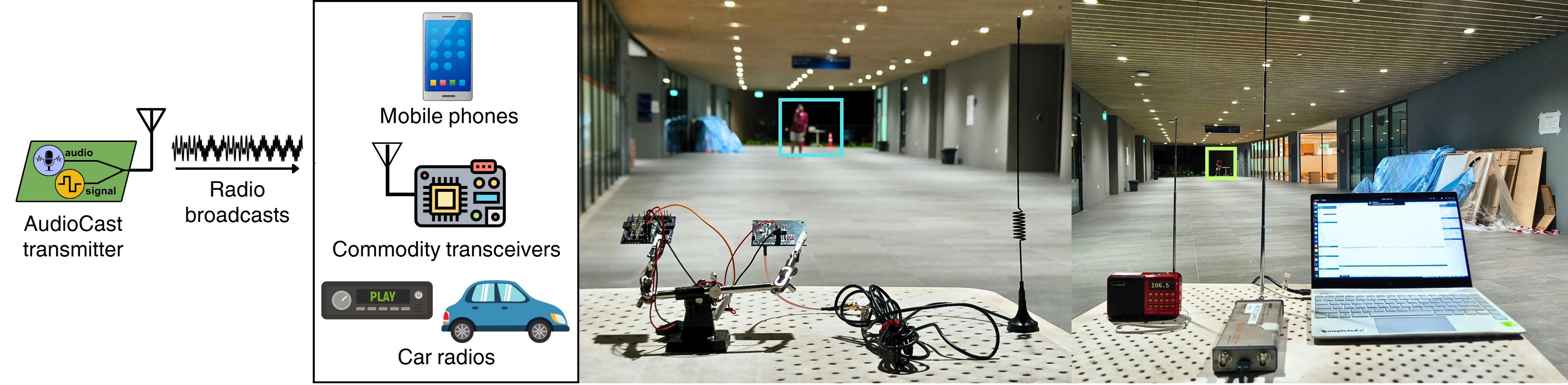
AudioCast rethinks radio transmitter design to solve two problems at once: spectrum contention and the high power cost of transmission. It uses a tunnel diode oscillator to generate a carrier signal and self-modulate it with a baseband signal directly, producing frequency-modulated transmissions at under 200 μW — without an externally generated or ambient carrier, unlike backscatter systems. We call this a Beyond-Backscatter transmitter.
AudioCast's transmitter architecture (left) and comparison against related low-power transmission approaches (right).
The transmissions are decodable by ordinary commodity FM receivers already deployed everywhere — cars, phones, home radios — reaching up to 130 m line-of-sight. Full details, evaluation, and applications (including low-power voice and gesture communication) are in the paper below (Reddy et al., 2025).
References
2025
IMWUT
AudioCast: Enabling Ubiquitous Connectivity for Embedded Systems through Audio-Broadcasting Low-power Tags
C. Rajashekar Reddy* , Dhairya Shah* , Nobel Ang , and Ambuj Varshney
Proceedings of the ACM on Interactive, Mobile, Wearable and Ubiquitous Technologies (IMWUT), Jun 2025
Wireless connectivity challenges hinder the deployment of embedded systems. We introduce AudioCast to address two critical issues: spectrum scarcity-induced contention and high power consumption in transmitters. The widespread availability of broadcast radio receivers (for example, FM radios using the 88–108 MHz spectrum) and access to underutilized lower-frequency spectrum motivate the design of AudioCast. The lower-frequency spectrum offers superior radio-wave propagation characteristics, exhibiting at least 10x lower path loss than the 2.4 GHz and 5 GHz Industrial, Scientific, and Medical (ISM) bands while avoiding congestion and interference. These properties enable reliable and long-distance communication, even for weakly radiated signals. AudioCast builds on these properties and the unique negative resistance of a tunnel diode. AudioCast rethinks the architecture of radio transmitters using a tunnel diode oscillator to generate carrier signals and self-modulate them with baseband signals. This results in frequency-modulated transmissions at an overall power consumption below 200 μW. Unlike related systems based on the backscatter mechanism, AudioCast does not require an externally generated carrier or rely on ambient signals. We argue that AudioCast represents an example of a new class of transmitters which we conceptualize as Beyond-Backscatter transmitters. Through experiments, we demonstrate that AudioCast achieves a transmission range of up to 130 m in line-of-sight and tens of meters in non-line-of-sight conditions.
@article{reddy2025audiocast,title={AudioCast: Enabling Ubiquitous Connectivity for Embedded Systems through Audio-Broadcasting Low-power Tags},author={Reddy, C. Rajashekar and Shah, Dhairya and Ang, Nobel and Varshney, Ambuj},journal={Proceedings of the ACM on Interactive, Mobile, Wearable and Ubiquitous Technologies (IMWUT)},volume={9},number={2},article={27},year={2025},month=jun,pages={1--32},doi={10.1145/3729471},co_primary={Shah, Reddy},category={Full Paper}}